December can mean extra driving: collecting people from stations, visiting family, late runs to the shops. It also means more people glancing at a phone at the wheel to see whether someone has set off yet. This article sets out what the law says about phones and driving, and how to use an arrival alert like ETA in a way that keeps your hands off the phone.
It’s general information, not legal advice. The rules below are for Great Britain; check the official pages for the full wording.
The basic rule
GOV.UK’s page on phones and driving is blunt: it’s illegal to hold and use a phone, sat nav, tablet or any device that can send or receive data while you’re driving or riding a motorcycle. You must not use a device in your hand “for any reason, whether online or offline”. That includes texting, calling, taking photos or videos and browsing the web.
People are often surprised by when the rule applies. According to GOV.UK it still applies when you’re:
- stopped at traffic lights or queuing in traffic;
- supervising a learner driver;
- in a car that switches its engine off when it stops;
- using a device that’s offline or in flight mode.
The Highway Code (rule 149) says the same: you must not pick up and use a hand-held phone while stationary in traffic, and the rule applies even when the device can’t connect.
The exceptions
GOV.UK lists a short set of situations where you can hold a device:
- to call 999 or 112 in an emergency, when it’s unsafe or impractical to stop;
- when you’re safely parked;
- to make a contactless payment in a vehicle that isn’t moving, for example at a drive-through;
- to park the vehicle remotely with a device.
“Safely parked” is the one that matters for most of us. Pulling into a lay-by or car park and stopping properly is very different from picking the phone up in a queue.
Hands-free is allowed, but it isn’t free of risk
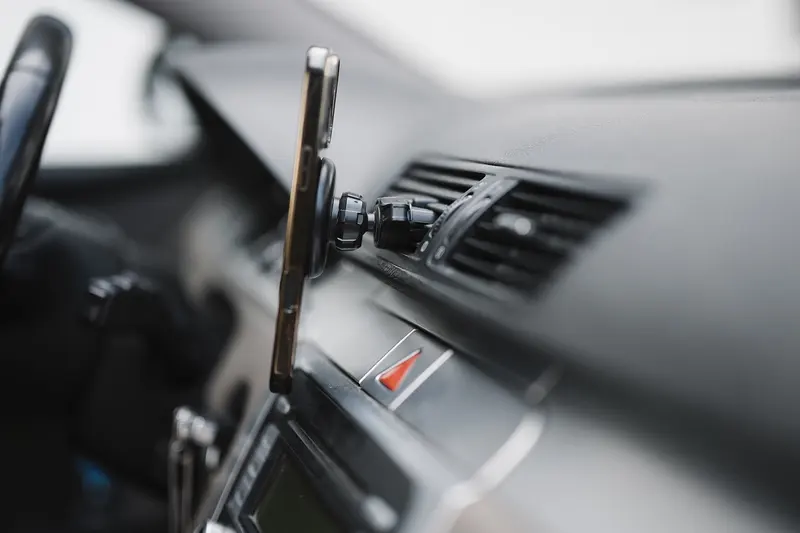
You can use a device hands-free if you don’t hold it at any time. GOV.UK gives examples: a Bluetooth headset, voice commands, a dashboard holder or mat, a windscreen mount or a built-in sat nav. The device must not block your view of the road and traffic ahead.
Two important warnings sit alongside that permission:
- GOV.UK says you must stay in full control of your vehicle at all times, and the police can stop you if they think you’re distracted.
- The Highway Code notes that using hands-free equipment is also likely to distract your attention from the road. Rule 150 adds that sat navs and other in-car systems can distract you, and that if you need to look at maps or screen information you should stop somewhere safe first.
So a phone in a holder is legal; reading a long message on it while moving is still a bad idea.
The penalties
According to GOV.UK:
- Holding and using a device can mean 6 penalty points and a £200 fine.
- If you passed your test in the last 2 years, you’ll lose your licence.
- Not having a full view of the road and traffic ahead, or not being in proper control of the vehicle, can mean 3 penalty points.
- If the case goes to court you can be banned from driving and fined up to £1,000 (£2,500 for a lorry or bus driver).
Using ETA if you’re the driver
ETA was designed with trains, buses and walking in mind, but plenty of people drive to the place where someone’s waiting. If you use it in the car, do all the setting up before you move:
- Set the destination and start the journey while parked. Choose the contacts, the distance or minutes, and whether to send the “on my way” email, all before you set off.
- Put the phone in a holder that doesn’t block your view of the road. ETA keeps the screen on while a journey runs (our page on why the screen has to stay open explains why), so a mount is the natural place for it.
- Leave it alone. The “nearly there” email goes automatically when you reach the distance or time you chose. You don’t need to press anything on the way.
- Tap “I’ve arrived” once you’ve parked, not while you’re pulling in. If you’ve chosen the automatic arrival email, there’s nothing to press at all.
- Let a passenger handle it if there is one. Passengers can use phones freely.
What ETA can’t do is make a phone safe to handle on the move. If a message from someone you’re collecting really needs an answer, find somewhere safe to stop first.
A simple habit for the season
Agree times as well as alerts. “I’ll be outside at about eight, I’ll wait in the car park” means nobody needs to text the driver at all — and the alert just confirms what you already planned. Our tips for commuters cover choosing sensible alert distances, and the safety page explains what ETA is and isn’t.
 · 3 min readCycling home in the dark: lights, reflectors and the Highway CodeFrom late autumn, many cycle commutes end after sunset. What the Highway Code says you must have on your bike at night, what it recommends you wear…
 · 3 min readPassenger Assist: booking help with a train journeyIf you need help getting on or off a train, finding your way through a station or with luggage, Passenger Assist can arrange it. How to book, how…
Drive safely, and leave the phone in its holder.