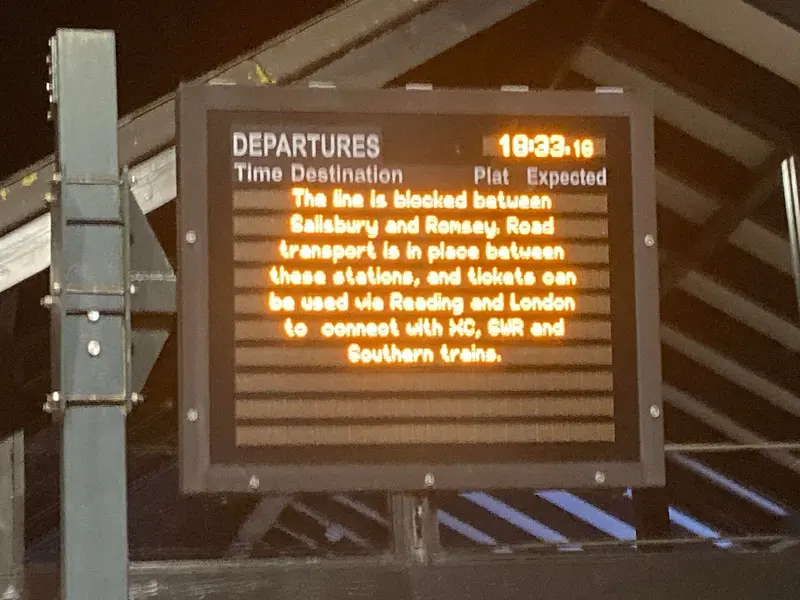
Winter weather, engineering works and the busy weeks around Christmas can all bring delays. If you use ETA on the train, you already know when you’re running late — your contacts get a later “nearly there” email. This article covers the other side: whether you can claim something back.
It’s general information, not advice on a particular claim. Each train company sets its own rules, so check theirs before you claim.
Delay Repay in brief
National Rail describes Delay Repay as a nationwide scheme that makes it easier to get compensation for delayed train journeys. It applies if you’re delayed for any reason on a participating National Rail service — not only when the delay was the train company’s fault. National Rail lists the train companies that take part.
The key points from National Rail’s page:
- You claim from the train company that ran the service, not from National Rail.
- The delay is measured against the timetable — either the normal one, or an amended timetable published in advance. So if engineering works were announced and the timetable changed beforehand, the delay is measured against that new timetable.
- The amount depends on the train company, your type of ticket and how long you were delayed. National Rail’s example: a delay of over an hour generally earns more compensation than one of 15 to 30 minutes.
- Each company’s threshold is in its Passenger’s Charter, on its website. The National Rail Conditions of Travel set a minimum, and National Rail says most companies pay more than the minimum and also pay for shorter delays.
- Season tickets are worked out differently from day tickets.
How to claim
According to National Rail, claims can be made online, or by post using a form from the train company’s website. Staffed stations also have the forms. Some companies let you register certain tickets online in advance, which speeds up later claims.
Time limits and the evidence you need vary by company — check the train company’s own Delay Repay page before you start. Keeping your ticket (or the e-ticket and booking email) is sensible in any case.
Note the time you actually arrived
A claim is about how late you arrived at your destination, compared with the timetable. It helps to make a quick note of:
- the train you caught, and the one you were booked on if different;
- the time you actually arrived;
- anything that happened on the way — a cancellation, a missed connection, a change of route.
If you use ETA’s “tell my people” mode with the arrival email, the time of that email gives you a rough reminder of when you got in. It isn’t evidence in itself, and the train company will use its own records, but it can jog your memory a week later.
If you decide not to travel
National Rail says that if you choose not to travel because your train is delayed or cancelled, or you can’t complete your journey, your unused ticket can be refunded without any fees by the original retailer — the train company or website you bought it from. Tickets from a ticket machine should say how to get a refund.
That’s worth knowing before a day with a Met Office warning out: our post on weather warnings explains how to read them.
If you’re not happy with the answer
Complain to the train company first. If that doesn’t sort it out, the Rail Ombudsman is an independent, not-for-profit body that offers a free service for unresolved complaints about rail service providers. It asks you to allow the company 40 working days to resolve your complaint, but you can go to the Ombudsman sooner if the company sends you a final response (sometimes called a “deadlock letter”).
Over Christmas and New Year
Many routes run reduced or replacement services over the holidays, and engineering work is often planned well in advance. Delays are measured against the amended timetable where one was published in advance, so a planned bus replacement isn’t itself a delay. Our Christmas and New Year by train post covers what to check before you go.
And for whoever is waiting
A late train is less stressful when the person collecting you knows. ETA’s alert is based on where you actually are, so it goes when you’re genuinely close — not when the timetable says you should be. See how it works.
 · 3 min readCycling home in the dark: lights, reflectors and the Highway CodeFrom late autumn, many cycle commutes end after sunset. What the Highway Code says you must have on your bike at night, what it recommends you wear…
 · 3 min readPassenger Assist: booking help with a train journeyIf you need help getting on or off a train, finding your way through a station or with luggage, Passenger Assist can arrange it. How to book, how…
Keep the ticket, note the time, and check your train company’s Delay Repay page — it’s often worth the few minutes it takes.