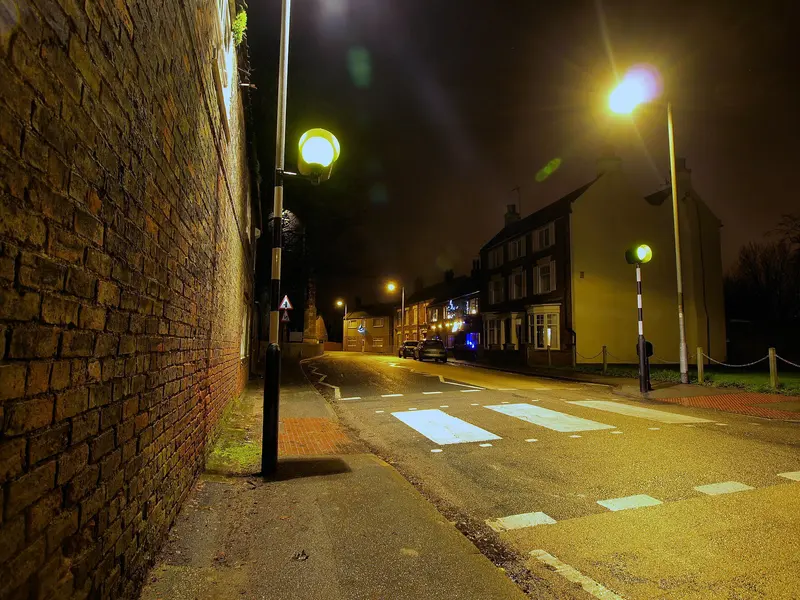
By late November it’s dark before most people leave work, and it stays dark until well after the morning commute has started. For anyone who walks from the station or bus stop, that last stretch home is now usually under street lights — or without them.
Our post on getting home on dark winter evenings looked at personal safety. This one is about something simpler: making sure drivers can see you. Everything below comes from the Highway Code’s rules for pedestrians. It’s general information; read the full rules on GOV.UK.
Reflective beats bright after dark
Rule 3 is the one most people half-remember. It says that when it’s dark you should use reflective materials — it gives armbands, sashes, waistcoats, jackets and footwear as examples — because these can be seen by drivers using headlights up to three times as far away as non-reflective materials.
That’s worth thinking about when you choose a winter coat or bag. A dark coat on a dark road is very hard to see, even in a lit street. A reflective strip on a bag, a band on a sleeve or reflective details on shoes cost little and make a real difference to how early a driver notices you.
Rule 17, for walking at night, repeats the point: wear something reflective to make it easier for others to see you.
Where there’s no pavement
Plenty of journeys end on a lane or a village road with no footway at all. Rule 2 says that if there’s no pavement you should keep to the right-hand side of the road, so that you can see oncoming traffic. That way the vehicles nearest to you are coming towards you, not up behind you.
If a road feels unsafe to walk on in the dark, a slightly longer route on a lit pavement is often the better choice.
Crossing the road at night
The Green Cross Code in rule 7 applies at any time of day: find a safe place to cross where there’s space to reach the pavement on the other side; stop just before the kerb, where you can see if anything is coming; and when it’s safe, go straight across — don’t run.
Two extra points matter after dark:
- Cross near a street light. Rule 17 says that if there’s no pedestrian crossing nearby, cross near a street light so that traffic can see you more easily.
- Watch for turning traffic. Rule 8 says that at a junction, traffic should give way to people crossing or waiting to cross — but also to look out for vehicles turning into the road, especially from behind you, and to cross where drivers can see you.
Winter weather makes it harder
Rain, fog and spray all reduce how far a driver can see, and wet roads take longer to stop on. If the Met Office has a warning out for fog, ice or heavy rain where you are, allow extra time for the walk and assume drivers will see you later than usual. Our post on Met Office weather warnings explains what the colours mean.
Phones and walking
ETA keeps the screen on during a journey so it can follow where you are. That doesn’t mean you need to watch it. Once you’ve set your destination, the phone can go in a pocket: the alarm and the emails don’t need you to look. If you do need to check something, stop at the side of the pavement rather than reading as you cross. A phone screen at night also ruins your night vision for a few seconds — not ideal on an unlit lane.
A short checklist for the dark months
- Something reflective on your coat, bag or shoes.
- Walk facing traffic where there’s no pavement.
- Cross at crossings, or near a street light.
- Phone away when you’re crossing.
- Tell someone roughly when to expect you, so they don’t need to keep messaging. ETA’s arrival alerts can do that automatically.
 · 3 min readCycling home in the dark: lights, reflectors and the Highway CodeFrom late autumn, many cycle commutes end after sunset. What the Highway Code says you must have on your bike at night, what it recommends you wear…
 · 3 min readPassenger Assist: booking help with a train journeyIf you need help getting on or off a train, finding your way through a station or with luggage, Passenger Assist can arrange it. How to book, how…
None of this is complicated, but in December it’s easy to forget. A reflective strip and a lit crossing are worth more than any app.